Let have density . As you have seen, the random variable comes up frequently in calculations. Thus far, all we have needed is which can be found by the formula for the expectation of a non-linear function of . To find the density of , we can’t directly use the change of variable formula of the previous section because the function is not monotone. It is two-to-one because both and have the same square.
In this section we will find the density of by developing a modification of the change of variable formula for the density of a monotone function of . The modification extends in a straightforward manner to other two-to-one functions and also to many-to-one functions.
16.4.1Density of 
If can take both positive and negative values, we have to account for the fact that there can be two mutually exclusive ways in which the event can happen: either has to be near the positive square root of or near the negative square root of .
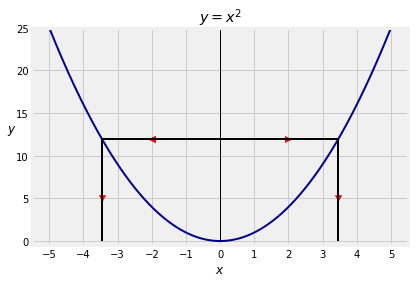
So the density of at has two components, as follows. For ,
where
and
We have used when .
For a more formal approach, start with the cdf of :
Differentiate both sides to get our formula for ; keep an eye on the two minus signs in the second term and make sure you combine them correctly.
This approach can be extended to any many-to-one function . For every , there will be one component for each value of such that .
Answer
No, the square is one-to-one on . For , .
Answer
for . Yes, the square is two-to-one on . For , .
16.4.2Square of the Standard Normal
Let be standard normal and let . The possible values of are non-negative. For a possible value , the formula we have derived says that the density of is given by:
By algebra, the density can be written in an equivalent form that we will use more frequently.
This is a member of the family of gamma densities that we will study later in the course. In statistics, it is called the chi squared density with one degree of freedom.