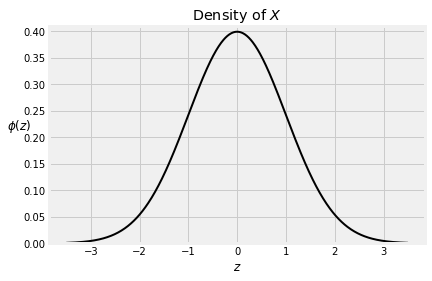
Though we have accepted the formula for the standard normal density function since Data 8, we have never proved that it is indeed a density – that it integrates to 1. We have also not checked that its expectation exists, nor that its SD is 1.
It’s time to do all that and thereby ensure that our calculations involving normal densities are legitimate.
We will start by recalling some facts about the apparently unrelated Rayleigh distribution, which we encountered as the distribution of the square root of an exponential variable.
Let have the exponential distribution. Then that has the Rayleigh distribution, with density given by
and cdf given by
In fact there is a family of Rayleigh distributions, each of whose members has the distribution of for some positive constant . But let us define to have “the” Rayleigh distribution, and let’s see what has to do with standard normal variables.
🎥 Constant of Integration
18.1.1The Constant of Integration
Let and be independent standard normal variables. Since we haven’t yet proved that the constant of integration in the standard normal density should be , let’s just call it . Then, by independence, the joint density of and is
The joint density at is a function of . Regardless of the value of the constant , the joint density has circular symmetry: if two points on the plane are at the same radial distance from the origin, then the joint density is the same at those two points. Let’s make this more clear in our notation.
Now let . To find the density of , let’s try to calculate . The event is shown in the diagram below.
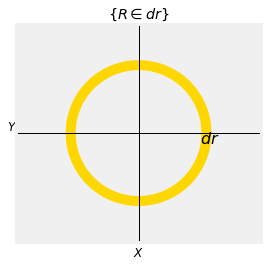
To find the corresponding volume under the joint density surface, two observations will help.
Because of circular symmetry, the joint density surface is essentially at a constant height over the entire gold ring. The height is .
The area of the ring is essentially that of a rectangle with width and length equal to the circumference .
Hence
So the density of is
Compare this with the Rayleigh density. The two are exactly the same except that the constants look different. The constant is 1 for the Rayleigh and for our new . But as both functions are densities, the constants must be equal. Hence , which means
Now we know that the standard normal density is indeed a density.
def indep_standard_normals(x,y):
    return 1/(2*math.pi) * np.exp(-0.5*(x**2 + y**2))

Plot_3d((-4, 4), (-4, 4), indep_standard_normals, rstride=4, cstride=4)
plt.title('Joint Density of $X$ and $Y$');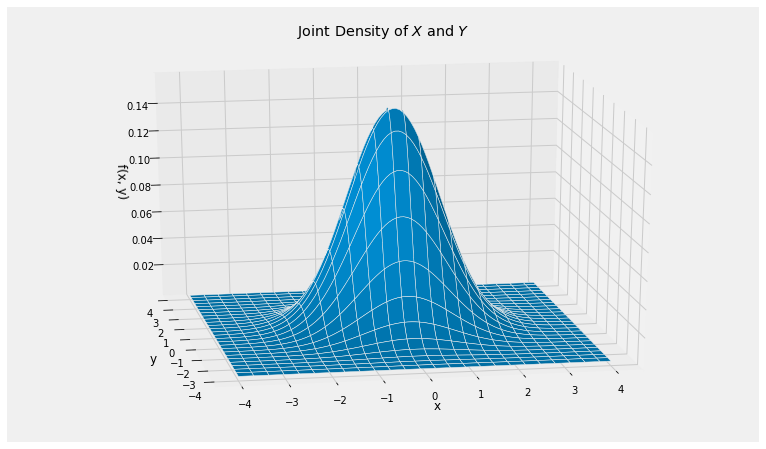
18.1.2Expectation
If is standard normal and exists, then has to be 0 by symmetry. But you have seen in exercises that not all symmetric distributions have expectations; the Cauchy is an example. To be sure that we should first check that is finite. Let’s do that.
Not only have we shown that is finite and hence , but we have also found the value of .
18.1.3Variance
If and are independent standard normal variables, then we have shown that has the Rayleigh distribution.
You also know that the Rayleigh distribution arises as the distribution of the square root of an exponential random variable.
It follows that if and are independent standard normal, then has the exponential distribution.
We will study this more closely in a later section. For now, let’s make two observations about expectation.
has the exponential distribution, so .
and are identically distributed, so .
Therefore . We know that . So and hence .