You have seen in exercises that a non-negative random variable has the gamma distribution for two positive parameters and if the density of is given by
Here
is the Gamma function applied to , and is part of the constant that makes the density integrate to 1.
As you have shown, the key fact about the Gamma function is the recursion
which implies in particular that
You have put all this together to show that
You have observed that the square of a standard normal variable has the gamma distribution, and that the exponential distribution is the same as the gamma distribution.
18.3.1The Rate 
For fixed , the larger is, the smaller is expected to be. Also like the exponential, the parameter essentially identifies the units of measurement – for a positive constant , the random variable has the gamma distribution. You can see this by applying the linear change of variable formula for densities. For positive , the density of is
SciPy calls the “scale” parameter of the gamma distribution. Because the parameter just determines the scale on the horizontal axis of the graph of the density, it is often taken to be 1. That’s what we will do to study the other parameter .
Answer
gamma
18.3.2The Shape Parameter 
Here are the graphs of the gamma densities for , 1.5, and 2.
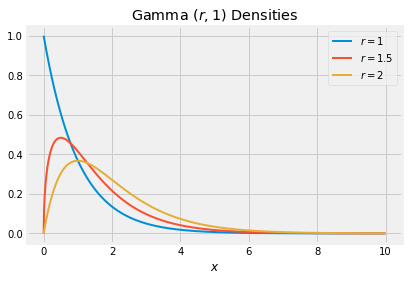
When the density is exponential. As gets larger the density moves to the right and flattens out, consistent with the increasing mean and SD .
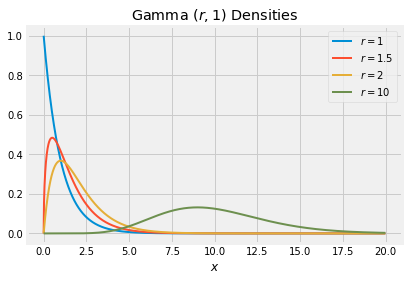
You can see why the gamma family is used for modeling right-skewed distributions. However, when , the gamma density looks almost normal. To see why, we will examine sums of independent gamma variables.
18.3.3Sums of Independent Gamma Variables with the Same Rate
If has the gamma distribution and independent of has the gamma distribution, then has the gamma distribution.
Note that for the result to apply, the rate parameter has to be the same for and . The rate parameter turns out to be the same for as well, and the shape parameters add up.
We will prove this result in the next chapter along with the corresponding result for sums of independent normal variables. For now, let’s test out the result by simulation just as we did with the sums of normals. The first three lines in the cell below set the values of , , and . The rest simulates 10000 values of and plots the gamma density over the simulated values.
# Change these three parameters as you wish.
lam = 1
r = 3
s = 7

# Leave the rest of the code alone.
x = stats.gamma.rvs(r, scale=1/lam, size=10000)
y = stats.gamma.rvs(s, scale=1/lam, size=10000)
w = x+y
Table().with_column('X+Y', w).hist(bins=20)
t = np.arange(min(w), max(w)+0.1, (max(w) - min(w))/100)
dens = stats.gamma.pdf(t, r+s, scale=1/lam)
plt.plot(t, dens, color='red', lw=2, label='gamma $(r+s, \lambda)$')
plt.legend()
plt.title('$X$ is gamma$(r, \lambda)$; $Y$ is gamma$(s, \lambda)$ independent of $X$');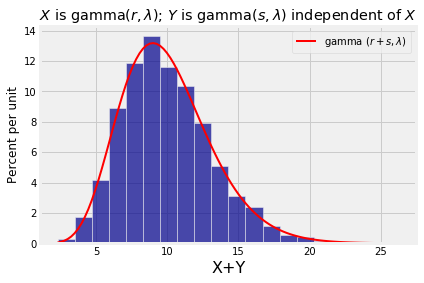
Answer
gamma
🎥 Gamma with Integer Shape Parameter
18.3.4Integer Shape Parameter
One of the two most important branches of the gamma family consists of gamma distributions that have an integer as the shape parameter.
Suppose are i.i.d. exponential variables. Then each of them has the gamma distribution. These are the fundamental members of the “integer shape parameter” branch.
By the fact we observed about sums of independent gamma variables, for all integers the sum has the gamma distribution. These are the other members of the branch.
You can now see why the gamma distribution is approximately normal for large . For integer , the sum of i.i.d. exponential random variables has the gamma distribution. For fixed and large , the Central Limit Theorem says the distribution of the sum is approximately normal.
Gamma distributions with integer shape parameter are a fundamental part of a stochastic process called a Poisson process which you will examine in exercises.
The other important branch of the gamma family is the topic of the next section.