The consecutive odds ratios of the binomial distribution help us derive an approximation for the distribution when is large and is small. The approximation is sometimes called the law of small numbers because it approximates the distribution of the number of successes when the chance of success is small: you only expect a small number of successes.
As an example, here is the binomial distribution. Note that 1000 is large, is pretty small, and is the natural number of successes to be thinking about.
n = 1000
p = 2/1000
k = np.arange(16)
binom_probs = stats.binom.pmf(k, n, p)
binom_dist = Table().values(k).probabilities(binom_probs)
Plot(binom_dist)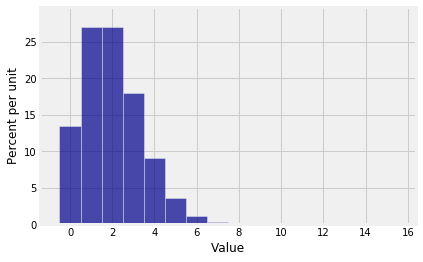
Though the possible values of the number of successes in 1000 trials can be anywhere between 0 and 1000, the probable values are all rather small because is small. That is why we didn’t even bother computing the probabilities beyond .
Since the histogram is all scrunched up near 0, only very few bars have noticeable probability. It really should be possible to find or approximate the chances of the corresponding values by a simpler calculation than the binomial formula.
To see how to do this, we will start with .
6.6.1Approximating 
Remember that is very close to the mode of the binomial distribution. Now let and in such a way that .
There are two reasons for the condition that converges to some positive number .
To ensure that doesn’t go to 0 so fast compared to that goes to 0 as well, because in that case all the probability just gets concentrated at the possible value 0
To ensure that doesn’t go to 0 so slowly compared to that goes off to , because in that case all the probability drifts off the number line into the void
Let be the binomial probability of successes.
Then
One way to see the limit is to appeal to our familiar exponential approxmation:
when is large, because and .
🎥 See More
6.6.2Approximating 
In general, for fixed ,
when is large, because is constant, , , and .
For large , remember that . So
By induction, this implies the following approximation for each fixed .
if is large, under all the additional conditions we have assumed. Here is a formal statement.
🎥 See More
6.6.3Poisson Approximation to the Binomial
Let and in such a way that . Let be the binomial probability of successes. Then for each such that ,
This is called the Poisson approximation to the binomial. The parameter of the Poisson distribution is for large .
The distribution is named after its originator, the French mathematician Siméon Denis Poisson (1781-1840).
Answer
The terms in the approximation are proportional to the terms in the series expansion of :
The expansion is infinite, but we are only going up to a finite (though large) number of terms . You now start to see the value of being able to work with probability spaces that have an infinite number of possible outcomes.
We’ll get to that in a later section. For now, let’s see if the approximation we derived is any good.
6.6.4Poisson Probabilities in Python
Use stats.poisson.pmf just as you would use stats.binomial.pmf, but keep in mind that the Poisson has only one parameter.
Suppose and . Then the exact binomial chance of 3 successes is
stats.binom.pmf(3, 1000, 2/1000)0.18062773231746918The approximating Poisson distribution has parameter , and so the Poisson approximation to the probability above is
stats.poisson.pmf(3, 2)0.18044704431548356Not bad. To compare the entire distributions, first create the two distribution objects:
k = range(16)

bin_probs = stats.binom.pmf(k, 1000, 2/1000)
bin_dist = Table().values(k).probabilities(bin_probs)

poi_probs = stats.poisson.pmf(k, 2)
poi_dist = Table().values(k).probabilities(poi_probs)
The prob140 function that draws overlaid histograms is called Plots (note the plural). The syntax has alternating arguments: a string label you provide for a distribution, followed by that distribution, then a string label for the second distribution, then that distribution.
Plots('Binomial (1000, 2/1000)', bin_dist, 'Poisson (2)', poi_dist)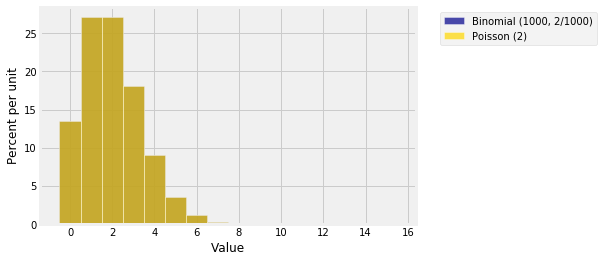
Does it look as though there is only one histogram? That’s because the approximation is great! Here are the two histograms individually.
Plot(bin_dist)Plot(poi_dist)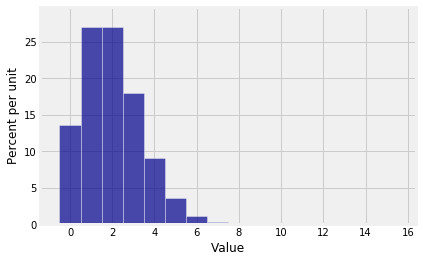
In lab, you will use total variation distance to get a bound on the error in the approximation.
A reasonable question to ask at this stage is, “Well that’s all very nice, but why should I bother with approximations when I can just use Python to compute the exact binomial probabilities using stats.binom.pmf?”
Part of the answer is that if a function involves parameters, you can’t understand how it behaves by just computing its values for some particular choices of the parameters. In the case of Poisson probabilities, we will also see shortly that they form a powerful distribution in their own right, on an infinite set of values.